Updated August 26, 2026: a source has since been identified for a large share of these illnesses. CDPHE has linked 110 Colorado cases to the multistate Salmonella Javiana outbreak linked to fresh jalapeno peppers distributed by Coast Citrus Distributors, and the state’s investigation pointed to Chipotle and Qdoba as restaurants that served the affected peppers. Both chains stopped serving them, and state and federal officials say they do not believe there is an ongoing risk from eating at those restaurants. The section below preserves what CDPHE reported when it first raised the alert on July 28.
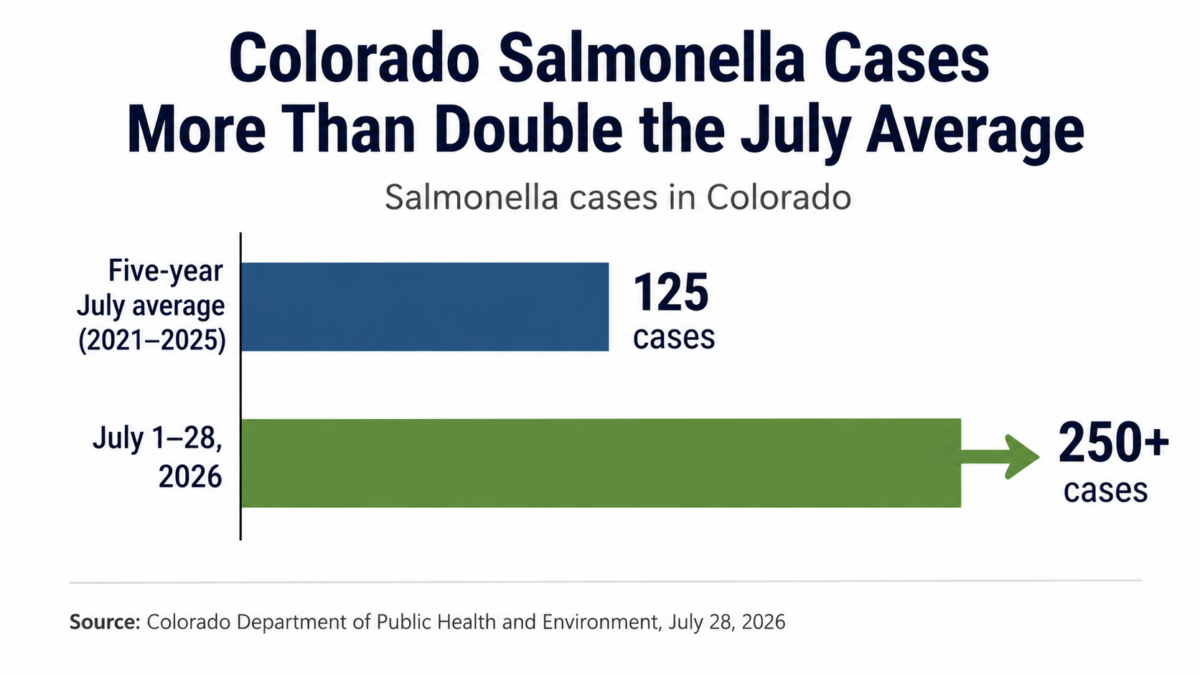
Colorado reported far more Salmonella illnesses in July 2026 than it normally sees. The Colorado Department of Public Health and Environment (CDPHE) said more than 250 cases had been reported since July 1, 2026, against a five-year July average of 125. Pritzker Hageman food safety attorneys are following the investigation and have published their own report on the Colorado Salmonella increase.
What Colorado health officials reported
CDPHE issued its alert on July 28, 2026. The department’s announcement says that as of July 28, more than 250 Salmonella cases had been reported in the state since July 1, and that Colorado has averaged 125 cases during the month of July over the past five years. That is more than double the usual count for the month.
The alert asks Coloradans to be aware of the symptoms and to contact a healthcare provider if they have them. It does not report a number of hospitalizations or deaths, and it does not name any suspect food. CDPHE says it will provide additional information as the investigation develops. Food Poisoning Bulletin is also following the increase in Colorado Salmonella illnesses, and Pritzker Hageman maintains an archive of Salmonella outbreak news as investigations like this one develop.
Jalapeno peppers were later identified as a source
When CDPHE issued its July 28 alert, it said federal investigators had not confirmed a specific food, restaurant, supplier or other source, and that tracing was underway. That changed in early August. CDPHE told the Colorado Sun on August 6, 2026 that the state had identified 110 Colorado cases belonging to a multistate outbreak, and that its investigation pointed to two restaurant chains serving the contaminated peppers, Chipotle and Qdoba. Agency spokesperson Kayla Glad said both chains stopped serving the affected jalapenos once they were notified. State and federal authorities said they did not believe there was an ongoing risk to consumers from eating at those restaurants.
FDA’s traceback investigation identified a common grower in Sinaloa, Mexico that supplies Coast Citrus Distributors as the likely source in that outbreak, and FDA recommended that Coast Citrus Distributors conduct a recall. As of the CDC’s August 21, 2026 update, that outbreak accounted for 431 illnesses in 32 states, 57 hospitalizations and no deaths, with illnesses beginning between June 19 and August 2, 2026. We cover it in detail in our report on the jalapeno Salmonella outbreak.
Two points are worth keeping straight. The 110 jalapeno-linked cases are a large share of Colorado’s July increase but not all of it, and CDPHE has not said that every additional case that month belongs to that outbreak. Pritzker Hageman’s Salmonella outbreak FAQ covers how these investigations unfold and what gets published at each stage.
How a cluster like this gets spotted
CDPHE points to its own laboratory capacity as the reason the increase surfaced. The Colorado Public Health Laboratory uses whole genome sequencing to compare the genetic fingerprints of Salmonella bacteria taken from people who test positive. Cases that look unrelated on a map can turn out to share a nearly identical fingerprint, which tells investigators the people probably ate the same contaminated food. That testing is also what lets officials detect an increase early, before a source is known.
There are many types of Salmonella bacteria, as CDPHE notes, and the alert does not name a single strain behind the increase. Pritzker Hageman explains how Salmonella bacteria cause illness and describes individual types such as Salmonella Enteritidis.
A separate national egg outbreak is also under investigation
CDC and FDA are investigating a multistate outbreak of Salmonella Enteritidis infections linked to shell eggs recalled by Midwest Poultry Services, L.P. As of July 24, 2026, CDC reports 98 illnesses in 17 states, 26 hospitalizations and no deaths in that outbreak.
CDPHE’s July 28 alert does not attribute Colorado’s increase to those eggs or to any other product. The two should be read as separate investigations unless officials say otherwise. If you have shell eggs at home, check the carton codes against the recall notice, since the recalled eggs carry specific plant and date codes.
Salmonella symptoms and who is most at risk
CDPHE lists diarrhea, fever, stomach cramps, nausea and vomiting as symptoms of Salmonella and tells anyone experiencing them to contact a healthcare provider. CDC’s page on Salmonella signs and symptoms adds that symptoms usually start 6 hours to 6 days after infection and last four to seven days, and that the diarrhea may contain blood or mucus. Children under five, adults 65 and older, and people with weakened immune systems are the most likely to become severely ill.
CDC advises calling a doctor for diarrhea or vomiting lasting more than two days, bloody diarrhea, a fever above 102 degrees, or signs of dehydration such as little or no urination, very dark urine, a dry mouth or throat, or dizziness. A small share of infections spread from the intestines into the blood, bones, joints or the membranes around the brain, and some patients develop reactive arthritis, joint pain that can last months or years. Pritzker Hageman’s guide to Salmonella symptoms explains how long they last and what to do when a Salmonella infection turns fatal.
What to do if you got sick in Colorado this month
- See a healthcare provider and ask whether a stool test is appropriate. A laboratory-confirmed infection is what lets the state connect your illness to a cluster, and it is also what a claim would later rest on.
- Write down what you ate in the week before symptoms started, while it is still fresh. Investigators are actively looking for the common food, and detailed interviews are how that gets found.
- Keep receipts, card statements, loyalty account records and any leftover packaging. If a source is eventually named, that paperwork is the link between the announcement and your own illness.
- Cooperate with your local public health agency if it calls. Colorado’s ability to name a source depends on people answering those interviews.
Do you have a case?
A claim generally becomes possible once a laboratory-confirmed infection can be traced to food sold by an identifiable business. What people who were seriously sickened can do now is preserve the evidence above, because the strength of a later claim usually depends on what was documented at the time.
It is worth talking to a food safety lawyer sooner rather than later if an illness led to hospitalization, an infection that spread beyond the intestines, a long recovery, or the death of a family member. Pritzker Hageman’s Bad Bug Law Team represents people sickened in foodborne illness outbreaks nationwide, in Colorado as in any other state. The firm’s Salmonella attorneys explain the reasons people file a Salmonella lawsuit and how a food poisoning lawsuit works, and their food poisoning attorneys post updates as investigations like this one progress.