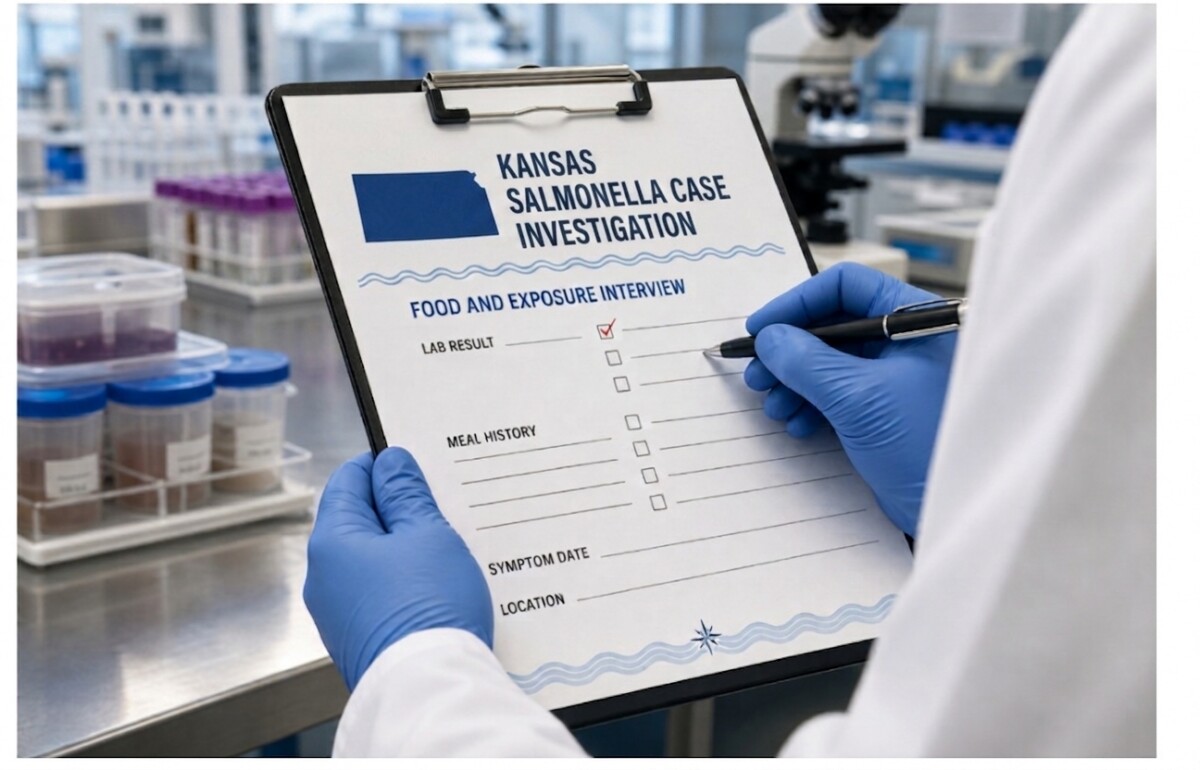
The Marshall County Health Department (MCHD) and the Kansas Department of Health and Environment (KDHE) are investigating a Salmonella outbreak among people who attended Axtell Days, a four day community festival held August 6 through August 9, 2026 in Axtell, Kansas. Officials announced the investigation on August 24 and are asking everyone who attended to fill out an online survey, whether or not they became ill.
KDHE told Food Poisoning Bulletin that five Marshall County residents who attended and ate food at the festival have laboratory-confirmed Salmonella infections. Two people were hospitalized. Health officials have also received anecdotal reports of additional illnesses after the event.
The outbreak was identified on August 18. KDHE has interviewed all five confirmed cases and obtained information from event organizers about the foods served, where they were sourced and how they were prepared.
As of August 26, 2026, neither agency has publicly released which Salmonella serotype is involved, or which food or vendor is under suspicion. The investigation is active and those details may change.
Pritzker Hageman’s food safety attorneys are following the investigation in their report on the Axtell Days Festival Salmonella outbreak in Kansas.
What Kansas officials have said
WIBW reported the investigation on August 24, 2026. The Marshall County Health Department (MCHD) is working with the Kansas Department of Health and Environment (KDHE) to find the source and the scope of the illnesses, and the two agencies have made a public appeal for information rather than issuing a warning about a specific product.
Attendees are asked to complete a state survey hosted by KDHE. Officials asked for responses from people who did not get sick as well. That is standard practice in an event investigation: comparing what ill and well attendees ate is usually how a single food is made to stand out from everything else served. Health officials say the survey takes roughly 10 to 15 minutes and participation is voluntary. People with questions can reach the Marshall County Health Department at 785-562-3485 or the KDHE epidemiology hotline at 877-427-7317.
What has not been released yet
KDHE has confirmed five laboratory-confirmed Salmonella cases among Marshall County residents who attended and ate food at Axtell Days, including two people who were hospitalized. Health officials have not publicly released the patients’ ages, illness onset dates or the Salmonella serotype. They also have not identified a specific food, vendor or other source of the outbreak.
KDHE has interviewed all five confirmed cases and collected information from event organizers about what foods were served, where they were sourced and how they were prepared. Officials are also reviewing responses to the attendee survey to look for exposures shared by people who became sick and to determine whether additional reported illnesses are connected to the outbreak.
No food recall has been announced in connection with Axtell Days. The investigation remains active, and health officials have said they will issue a report after the investigation and data analysis are complete.
Food Poisoning Bulletin obtained the updated case and hospitalization information directly from KDHE and is tracking developments in its coverage of the Axtell Days Salmonella outbreak.
If you attended Axtell Days
- Complete the KDHE survey even if you feel fine. A well attendee’s answers are as useful to investigators as a sick attendee’s, and the comparison between the two is what usually identifies the food.
- See a doctor if you developed diarrhea, fever or stomach cramps in the days after the festival, and ask specifically for a stool culture. A culture is what puts your illness into the official outbreak count and gives the state laboratory the genetic fingerprint it needs to link cases to one another.
- Write down what you ate and drank at the festival, which day and roughly what time, who you were with, and when your symptoms started. Memory for these details fades quickly, and investigators will ask for exactly this.
- Keep anything that documents the visit, including receipts, photographs of food, vendor names and text messages to friends about feeling ill.
- Watch young children and older adults closely. Dehydration develops fast in both groups, and signs include little or no urination, very dark urine, a dry mouth, dizziness and crying without tears.
Salmonella symptoms and when to call a doctor
According to Pritzker Hageman’s guide to Salmonella symptoms and how long they last, most people develop watery diarrhea that can contain blood or mucus, stomach cramps that can be severe, and fever. Some people also have headache, nausea, vomiting and loss of appetite. Symptoms usually begin 6 hours to 6 days after infection and usually last 4 to 7 days.
CDC advises calling a doctor for diarrhea or vomiting lasting more than two days, bloody stool or urine, a fever higher than 102 degrees Fahrenheit, or signs of dehydration. Anyone can get a Salmonella infection, but CDC identifies several groups as more likely to become seriously ill: children younger than 5 and especially infants under 1, adults 50 and older with underlying medical problems such as heart disease, adults 65 and older, and people with weakened immune systems.
Pritzker Hageman’s Salmonella outbreak FAQ answers the questions families ask most often after an event like this one. Our own Salmonella resource page collects the basics in one place.
When Salmonella becomes a serious illness
Most people recover at home without treatment. A minority do not, and those illnesses are the reason a festival outbreak is worth taking seriously even before anyone knows how many people are involved.
CDC reports that Salmonella can move out of the intestines and into the blood, bones, joints, urine or the membranes lining the brain and spinal cord, causing bloodstream infection, osteomyelitis, septic arthritis or meningitis. Some of those infections have lasting effects. A small number of patients develop reactive arthritis, joint pain that can persist for months or years and can progress to chronic arthritis, and CDC notes it is most common in people 15 to 35 years old. Some people have diarrhea for several months after the acute illness ends.
Pritzker Hageman explains that complication and its consequences in detail in its guide to reactive arthritis after a foodborne infection. If you were treated in an emergency room, admitted to a hospital, or told your infection had spread beyond your intestines, keep your medical records together. Those records are the difference between a documented case and a remembered one.
A separate Salmonella outbreak is also under investigation nationally
A larger, unrelated investigation was already running when Axtell Days took place. CDC and FDA are investigating a multistate outbreak of Salmonella Javiana infections linked to jalapeno peppers from Sinaloa, Mexico distributed by Coast Citrus Distributors. In its investigation update dated August 19, 2026, CDC reported 431 illnesses in 32 states, 57 hospitalizations among the 376 people with information available, and no deaths, with illness onsets ranging from June 19 to August 2, 2026.
No public health agency has connected the Axtell Days illnesses to that outbreak, and nothing published so far suggests the two are related. It is mentioned here only because anyone in Kansas who became ill with Salmonella this summer may reasonably be wondering which investigation, if either, their illness belongs to. That question is answered by laboratory testing, not by timing, which is another reason to ask for a stool culture. Pritzker Hageman’s Salmonella outbreak news coverage tracks both investigations, and we covered the summer’s other large Salmonella event in our report on the shell egg Salmonella outbreak.
When a Salmonella illness becomes a legal case
The illnesses that become cases are most often the serious ones: a hospital admission, an infection that spreads to the blood or the brain, a child or an older adult who needed intensive care, lasting joint or kidney damage, or a death.
An outbreak traced to a public event raises a different set of questions than a recalled packaged product. Who prepared and served the food, and under what permit? Was it a vendor, a caterer, a concession stand or a volunteer kitchen? Were temperature and handwashing requirements met, and did the local health department inspect the event? Was the ingredient itself contaminated before it ever reached Axtell? Those answers usually arrive with the health department’s investigation, which is another reason the survey matters.
Pritzker Hageman is a national food safety firm that handles these claims nationwide through its Bad Bug Law Team. The firm’s attorneys have published guides on Salmonella claims and when to contact a lawyer, on the reasons a Salmonella lawsuit is sometimes worth bringing, and on whether you can sue for food poisoning. Their Salmonella legal team page describes the attorneys who handle these cases and the outbreaks they have worked on.