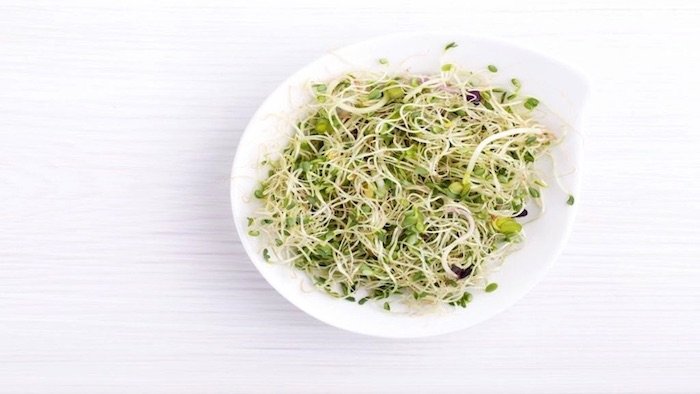
Updated October 2, 2026. A multistate outbreak of Shiga toxin-producing E. coli and Salmonella Agona linked to alfalfa sprouts has sickened 76 people in 16 states. Six people have been hospitalized, and no deaths have been reported. Illnesses began between May 31 and September 7, 2026. Of the 76 people sickened, 64 were infected with E. coli, nine with Salmonella and three with both E. coli and Salmonella.
Everything Sprouts alfalfa sprouts were identified as one source of illnesses through restaurant traceback in Minnesota and Wisconsin. The investigation has since moved farther up the supply chain. FDA traced illnesses to recalled alfalfa seed lot SAL2-24JB, which was supplied to Everything Sprouts and other sprout growers. CDC now advises people and businesses not to eat, sell or serve affected alfalfa sprouts or sprouting seeds.
The recalled Everything Sprouts and Calco alfalfa sprouts, Crunchy Protein Sprout Mix, Zesty Garlic Mix and certain lots of Robust Radish Sprout Mix are past their best-by dates and should no longer be available in stores or restaurants. The seed recall is broader, however, and includes alfalfa seed that was distributed to growers, wholesalers and, in some cases, consumers.
Pritzker Hageman’s food safety lawyers are following the investigation in their report on the Everything Sprouts and Calco alfalfa sprouts outbreak.
What officials have confirmed so far
CDC and FDA now report 76 illnesses in 16 states, including six hospitalizations and no deaths. The outbreak involves three strains of Shiga toxin-producing E. coli, O26:H11, O103:H25 and O168:H8, and one strain of Salmonella Agona. Illnesses began between May 31 and September 7, 2026.
The evidence linking the outbreak to alfalfa sprouts has also grown. Of 50 people interviewed about what they ate before becoming sick, 40, or 80%, reported eating sprouts and 35 specifically reported eating alfalfa sprouts. CDC says that is significantly higher than the 8.7% of people in its FoodNet Population Survey who reported eating any type of sprouts. Seven illness clusters have been identified in Minnesota and Wisconsin, and alfalfa sprouts were the food most commonly reported in those clusters.
Whole genome sequencing showed that bacteria from sick people were closely related genetically, indicating that the illnesses likely came from the same source. Traceback from Minnesota and Wisconsin restaurants identified alfalfa sprouts distributed by Everything Sprouts as a source of illnesses. FDA then traced illnesses to a single lot of alfalfa seed, SAL2-24JB, from a common seed supplier.
FDA enforcement records identify International Sprout Holdings Inc. of Cookeville, Tennessee, doing business as International Specialty Supply, as the company that recalled 43,799 pounds of alfalfa seed from lot SAL2-24JB because of possible E. coli and Salmonella contamination. FDA’s main outbreak page continues to refer to the company simply as the “seed supplier.”
Pritzker Hageman keeps a running resource on sprout recalls and the claims that come out of them.
The sprouts and where they were sold
The alfalfa sprouts were produced by Everything Sprouts, a Minnesota grower, and sold under two brand names, Calco and Everything Sprouts. Minnesota officials say the sprouts went to restaurants and grocery stores. Because sprouts are often added to sandwiches, wraps and salads at the point of service, a person can eat them without ever seeing a package or a brand name, which is one reason sprout outbreaks are difficult to trace and difficult for the public to self-screen.
Sprouts have a long history as an outbreak food. The seeds are germinated in warm, humid conditions, and those same conditions favor bacterial growth, so a small amount of contamination on the seed can multiply through a batch. Pritzker Hageman explains the pattern in their piece on why E. coli, Salmonella and Listeria illnesses from sprouts keep recurring.
Past sprouts outbreaks include the E. coli outbreak tied to clover sprouts served at Jimmy John’s and a Salmonella outbreak that prompted sprout recalls in Canada.
FDA Traced the Outbreak to Recalled Alfalfa Seed Lot SAL2-24JB
FDA and CDC now say recalled alfalfa seed lot SAL2-24JB may be contaminated with E. coli and Salmonella and may be making people sick. The seed was supplied to Everything Sprouts and other sprout growers, which helps explain why Everything Sprouts products did not account for every illness in the outbreak.
Berlin Seeds of Millersburg, Ohio later recalled 950 pounds of alfalfa sprouting seed after its supplier told the company the seed could be contaminated with STEC or Salmonella. Berlin Seeds sold the seed at its store and online to customers in 44 states. The 5-pound and 50-pound packages carry lot code SAL2-24JB, while the smaller 1/4-pound, 1/2-pound and 1-pound packages do not have a lot code.
Which Everything Sprouts and Calco Products are recalled?
The FDA recall announcement identifies these products:
- Everything Sprouts and Calco alfalfa sprouts, 5-ounce containers: lots 222, 223, 225, 226 and 230.
- Everything Sprouts Crunchy Protein Sprout Mix, 5-ounce cups: lots 222, 223, 226 and 230.
- Everything Sprouts Zesty Garlic Mix, 5-ounce cups: lots 222, 223, 225, 226 and 230.
- Robust Radish Sprout Mix, 5-ounce cups: lots 223, 226, 230 and 233.
FDA says the recalled alfalfa sprouts were distributed from May 27 through August 21, 2026. Robust Radish Sprout Mix was distributed from August 13 through August 26 and added to the recall on August 28.
Illnesses have been reported in 15 states. People may have eaten sprouts in a restaurant, deli, sandwich, wrap, salad or other prepared food without ever seeing a package or brand name.
The recalled Everything Sprouts finished products are now past their best-by dates and should no longer be available in stores or restaurants. FDA is still warning people not to use recalled sprouting seed or eat sprouts grown from recalled seed lot SAL2-24JB.
Berlin Seeds also recalled alfalfa sprouting seed from the same implicated lot. Unlike the Everything Sprouts finished-product recall, the Berlin Seeds recall reached consumers in 44 states and included packages ranging from 1/4 pound to 50 pounds.
FDA had already documented problems at this facility
Everything Sprouts, LLC is not new to federal scrutiny. FDA inspected the company’s sprouting operation at 2751 Minnehaha Avenue in Minneapolis from October 30 through November 14, 2024, and issued a public warning letter dated March 28, 2025.
FDA’s investigator recorded a roof leaking through ceiling tiles in the middle of the production room, about four feet from the packaging tables, with water dripping onto totes of cooled, exposed mung bean sprouts as pallets moved through for packaging. A second roof leak in the warehouse dripped near a rack of clean smocks waiting to be worn by employees who handle produce. Condensate was dripping from condenser units inside the coolers holding sprouts. The investigator also found a build-up of black organic matter on the overhead irrigation hose running above exposed soy sprouts, and torn plastic sheeting around growing cabins that had been patched with tape, with sprouts stuck to the tape in several places.
FDA concluded that the company’s mung bean, soybean and green sprout products were adulterated because they had been prepared, packed or held under insanitary conditions. The agency also noted that dripping condenser units had been observed at the same facility during inspections in 2018 and 2023, when it operated under different ownership, and that the company’s written response did not explain how it would fix the source of the roof leak. FDA closed by saying it would evaluate the adequacy of the corrective actions at its next inspection.
Two cautions belong with that history. The 2025 warning letter named mung bean, soybean and green sprouts, not alfalfa sprouts. And no agency has said that the conditions documented in 2024 caused the illnesses reported in 2026. The investigation into how these sprouts became contaminated is still open. What the letter does establish is that federal regulators had already put this operation on notice about water dripping onto exposed product, and that is a fact a family sickened this summer is entitled to know. We have written before about what an FDA warning letter to a sprout grower after an outbreak looks like.
Symptoms to watch for, and the one complication that changes everything
STEC infection usually brings stomach cramps and diarrhea, often bloody, with only a low-grade fever or none at all. The CDC says symptoms of an E. coli infection typically begin two to five days after exposure, though the range runs from one to eight days, and most people recover in five to seven days.
According to the CDC, Salmonella infection brings diarrhea, abdominal pain and fever, usually starting 12 to 96 hours after exposure, though onset can be delayed up to two weeks. Most infections clear in five to seven days, but about 28 percent of laboratory-confirmed Salmonella cases require hospitalization.
The complication to know about is hemolytic uremic syndrome, or HUS. A STEC infection can progress to HUS, a severe condition involving acute kidney failure. It most often strikes young children, and it can develop after the diarrhea seems to be improving. Warning signs include decreased urination, unusual paleness or fatigue, easy bruising, and swelling.
HUS is a medical emergency. Pritzker Hageman maintains detailed information on hemolytic uremic syndrome and E. coli kidney failure, and separate guidance for parents on what to do when a child is diagnosed with E. coli.
Past E. coli outbreaks have led to HUS infections, including a 2024 E. coli outbreak linked to Raw Farm cheddar cheese.
Diarrhea associated with STEC infection generally should not be treated with antibiotics, because antibiotics can promote the development of HUS. Anyone who believes they may have a STEC infection should contact a health care provider rather than self-treating.
What to do right now
- Check your refrigerator for recalled Everything Sprouts and Calco alfalfa sprouts, Crunchy Protein Sprout Mix, Zesty Garlic Mix and Robust Radish Sprout Mix. Do not eat recalled products.
- Save any package, lot information, receipt, photograph, delivery-app order or other record that may help identify the product or place of purchase.
- Do not treat the absence of a recall as proof a product is safe. FDA has said the implicated alfalfa seed lot also went to at least one other grower. On September 15, 2026, FDA said the seed supplier agreed to recall that lot and that the growers and wholesale distributors who received it have been contacted directly, and FDA says sprouts grown from the recalled seed should have been recalled and should no longer be for sale. If you are uncertain about any alfalfa sprouts you have, the safe choice is to throw them out.
- If you bought sprouts loose or ate them on a sandwich or salad at a restaurant or deli, you may not be able to identify the brand. Illnesses in this outbreak have been reported in 15 states with onsets going back to late May, so if you ate alfalfa sprouts anywhere since then and became ill, tell your doctor exactly what you ate and when.
- Clean any surfaces, containers or drawers the sprouts touched. STEC has a very low infectious dose, so cross-contamination in the refrigerator is a real route of exposure.
- See a doctor for bloody diarrhea, and ask for a stool culture. A culture is what puts your illness into the outbreak count and gives investigators the genetic fingerprint they need. It is also, later, the difference between a documented case and a suspected one.
- Watch a sick child closely even as the diarrhea improves, and seek emergency care for decreased urination, extreme paleness or unusual bruising.
Food Poisoning Bulletin is also tracking the investigation and posting updates as the states release them, in its coverage of the Calco and Everything Sprouts outbreak in Minnesota.
Can I sue for E. coli food poisoning?
Most people who get food poisoning recover at home and have no reason to call a lawyer. The illnesses that turn into cases are the serious ones: a child who develops HUS and needs dialysis, an adult hospitalized with kidney or neurological complications, a long hospital stay, lasting damage, or a death.
In this outbreak, FDA reported 55 illnesses in 15 states and four hospitalizations on its outbreak page, current as of September 15, 2026. No deaths have been reported. The investigation remains active, and additional illnesses or distribution information may still be identified.
When an outbreak is traced to a named grower and named brands, the legal questions are usually about the supply chain. Was the product adulterated when it left the facility? Did the grower meet the sprout safety requirements that apply to it? What did the retailer or restaurant know, and when? A confirmed laboratory match to the outbreak strain is powerful evidence, which is why the stool culture matters so much in an E. coli lawsuit.
Pritzker Hageman, a national food safety firm, handles these claims nationwide through its Bad Bug Law Team. Their attorneys have published legal guides on whether you can sue a grocery store for food poisoning, on E. coli outbreak litigation and on Salmonella claims and when to contact a lawyer. Because this outbreak centers on a Minnesota grower and Minnesota patients, their guide for Minnesota E. coli claims is a useful starting point, and their ongoing E. coli outbreak news coverage is where updates on this investigation will appear first.